I have been involved with TeachMeets from before the name was invented and have always found them to be fascinating and challenging in roughly equal measure. (For a history lesson, see TeachMeet Beginnings … in Falkirk? and TeachMeet – The Story So Far...)
The next one I'm going to attend will be TeachMeet Computing Edition. This is an event created especially for Scottish Computing teachers and it is a good example of the way the TeachMeet idea has grown and developed. However, although there have been many positive developments (such as specialist, regional and international TeachMeets) occasionally things have gone adrift. It is pleasing to note therefore that Ewan McIntosh, who was so important in establishing the TeachMeet concept, is challenging people to look at what is happening and re-energise the TeachMeet ideal.
To this end, he started an online conversation (which I have been following but haven't got organised enough to reply to yet) and also co-ordinated a simultaneous blog post which sets out concerns, questions and seeks comment (which I wasn't organised enough to post on this blog - are you spotting a theme yet?). You can read the post on Ewan's blog or on one of the umpteen other blogs that carried it. It seems to have been successful in stirring up a debate!
I'm not sure where we will end up but I am sure that TeachMeet will be stronger in the future thanks to people like Ewan.
If you haven't done so already, drop by his blog post and join the conversation.
Showing posts with label Ewan McIntosh. Show all posts
Showing posts with label Ewan McIntosh. Show all posts
Thursday, June 03, 2010


Saturday, March 06, 2010
Fun on Friday #62: Swedish Advert
I think this is a genuine advert but it's one you can personalise. Stick with it until about half-way through to see how it has been personalised:
I hope you agree with me that it is stunningly well done. Could you use this in school or is it just a bit of fun? Either way, you can make your own at this Swedish advertising site.
I'm just back from the first Glasgow EduBlether and I've been thinking a fair bit about the up-coming TeachMeet Student Edition - Glasgow, so it seemed appropriate to use an image of Ewan McIntosh for today's fun on Friday. Helpfully, Ewan has made a number of publicity shots available on his Flickr account, so I used this one. Thanks Ewan - I hope you don't mind.
I hope you agree with me that it is stunningly well done. Could you use this in school or is it just a bit of fun? Either way, you can make your own at this Swedish advertising site.
I'm just back from the first Glasgow EduBlether and I've been thinking a fair bit about the up-coming TeachMeet Student Edition - Glasgow, so it seemed appropriate to use an image of Ewan McIntosh for today's fun on Friday. Helpfully, Ewan has made a number of publicity shots available on his Flickr account, so I used this one. Thanks Ewan - I hope you don't mind.
Tuesday, January 27, 2009
It's a matter of trust...
I picked this up via a news posting from Computing magazine: Wikipedia considers limiting user access. It seems that they are considering having trusted users that can edit Wikipedia pages straight away but other, newer users, will have to earn their trust as initially their edits will have to wait to be moderated.

It seems as though Wikipedia is caught between a rock and a hard place. One of the fundamental ideas of Wikipedia is that it is "the free encyclopedia that anyone can edit..." and yet, thanks to the actions of a few numpties, they are having to re-consider this most basic of principles.
Perhaps Wikipedia are victims of their own success. They are so well known that they attract the numpties who are more interested in hindrance than help and they are so big, that there are quieter corners where acts of vandalism can sit unnoticed for a while.
Wikipedia's dilema led me to think again about the perenial debate on restricting access to the Internet in schools. Rather than just trying to block everyone from accessing sections of the Internet, would a trusted user system be a better way to go? Teachers would be trusted users and have (more or less) free access to all areas of the Internet. Pupils would earn increasingly trusted status as they get older and as they demonstrate a history of responsible behaviour. Would this satisfy schools' desire (need?) to protect the young people in their care while allowing appropriate use without overly restrictive blocking policies? To be honest, I'm not sure. I think we could end up with a system that is complex, clumsy and not much better than what we have just now. And of course, the untrustworthy will find ways round the system anyway (as they do at the moment!).
Final thoughts. I described the discussion of Internet restrictions in schools as a "perenial debate" but I wonder how wide this debate really is. For example, some recent discussions I've observed are Ewan McIntosh enlisting Barack Obama as an ally in the fight for openness, ("Yes we can!"), a consideration of whether the Internet should be instant or filtered, a fairy story and a wiki considering what education will look like in 2020. I suspect that it is a small minority of teachers, the already Internet/Web 2.0 savvy teachers, that are getting frustrated. Is it an issue that concerns the majority? How widely is it debated and discussed by people in a position to bring about changes to policy and practice at an authority or national level?
As usual, a blog post with more questions than answers.
Wednesday, January 21, 2009
Talking About Games...
I met Andrew Brown earlier in the week and we had a quick chat about BETT, the frustrations of site blocking in schools and... games in education.
A few of the things we said about games are, I think, worth repeating here.
Firstly, I said that roughly a quarter of the students I spoke to, claimed to be gamers. This illustrates something that Ewan McIntosh has said to our students on previous occasions - that the children who grew up playing games on home computers like the ZX Spectrum are now adults, parents even, and are still playing computer games. Andrew said that he had been surprised at the number of Playstation games in the shops with an 18+ rating. The image of the game player as a spotty teenage boy no longer holds water (if it ever did). {Comment: Having said that, I suspect there a a fair number of gamers under 18 who are playing 18+ games. Perhaps their parents are unaware, uncaring or uninformed.}
Another aspect related to gaming that struck me is the way Nintendo is advertising its products. It has families sitting on the couch playing games together and two people on a plane (Patrick Stewart and Julie Walters) bonding over More Brain Training on the DS.
As far as Nintendo is concerned, it is not just the spotty teenager bit that's wrong, the the stereotype of the isolated loner playing games is wrong too. I realise that most (all?) the modern games machines support networked multipayer games but Nintendo are going further. Gaming is a communal, family activity.
Does this have any relevance for games in education? I think it probably does. Increasing numbers of teachers will be gamers themselves and aware of the motivating power and immersive nature of commercial, off the shelf games. This combined with the rehabilitation of gamers in the media as mature, sensible adults and happy family members will hopefully make it easier to introduce games in he classroom.
Is this right? Am I being over overoptimistic? I'd be keen to know what you think.
I'll try to post my presentation on games in education soon (which draws heavily on the work of Derek Robertson). For now though I'll close with the observation that playing virtual tennis on the Wii has resulted in a very unvirtual pain in my arm! I made the mistake of trying to make up for lack of technique with brute strength... it didn't work. :-(
A few of the things we said about games are, I think, worth repeating here.

Firstly, I said that roughly a quarter of the students I spoke to, claimed to be gamers. This illustrates something that Ewan McIntosh has said to our students on previous occasions - that the children who grew up playing games on home computers like the ZX Spectrum are now adults, parents even, and are still playing computer games. Andrew said that he had been surprised at the number of Playstation games in the shops with an 18+ rating. The image of the game player as a spotty teenage boy no longer holds water (if it ever did). {Comment: Having said that, I suspect there a a fair number of gamers under 18 who are playing 18+ games. Perhaps their parents are unaware, uncaring or uninformed.}
Another aspect related to gaming that struck me is the way Nintendo is advertising its products. It has families sitting on the couch playing games together and two people on a plane (Patrick Stewart and Julie Walters) bonding over More Brain Training on the DS.
As far as Nintendo is concerned, it is not just the spotty teenager bit that's wrong, the the stereotype of the isolated loner playing games is wrong too. I realise that most (all?) the modern games machines support networked multipayer games but Nintendo are going further. Gaming is a communal, family activity.
Does this have any relevance for games in education? I think it probably does. Increasing numbers of teachers will be gamers themselves and aware of the motivating power and immersive nature of commercial, off the shelf games. This combined with the rehabilitation of gamers in the media as mature, sensible adults and happy family members will hopefully make it easier to introduce games in he classroom.
Is this right? Am I being over overoptimistic? I'd be keen to know what you think.
I'll try to post my presentation on games in education soon (which draws heavily on the work of Derek Robertson). For now though I'll close with the observation that playing virtual tennis on the Wii has resulted in a very unvirtual pain in my arm! I made the mistake of trying to make up for lack of technique with brute strength... it didn't work. :-(
Wednesday, September 24, 2008
SLF08: Thinking Out of the XBox
Live Blog of Ewan McIntosh's session at SLF.
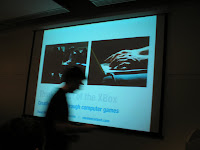 How often do we encourage our pupils? It can get a bit grating to be constantly offering praise. Has to be genuine.
Ewan started by saying it's about the process not the product (Gave example of Katie Melua re-writing song to make it more accurate but poorer love song.) He argued that concentration on final product can lead to mediocrity. He talked about the peer assessment possibilities of blogs.
How do you assess something like Watch the World? Do you just look at the final product?
What are games offering that traditional education doesn't? One thing is "levelling up". The idea of ever expanding challenges. Also the idea of cheat sheets to help people improve. Gives a new way of doing things. Gave the example of Ollie Bray using Guitar Hero as the focus for a Primary/Secondary transition project. They looked at venues for the concert, costs, orienteering round the building, designing guitars in CDT, designing posters in Art, writing biographies in English...
Gamers are getting older - 66% of gamers have children - Nintendads. But are teachers playing games? Ewan suggested teachers are under-represented.
Ewan showed the clip of Tim Rylands teaching. Asked us to consider what was traditional teaching and what was new? How was he praising?
 How often do we encourage our pupils? It can get a bit grating to be constantly offering praise. Has to be genuine.
Ewan started by saying it's about the process not the product (Gave example of Katie Melua re-writing song to make it more accurate but poorer love song.) He argued that concentration on final product can lead to mediocrity. He talked about the peer assessment possibilities of blogs.
How do you assess something like Watch the World? Do you just look at the final product?
What are games offering that traditional education doesn't? One thing is "levelling up". The idea of ever expanding challenges. Also the idea of cheat sheets to help people improve. Gives a new way of doing things. Gave the example of Ollie Bray using Guitar Hero as the focus for a Primary/Secondary transition project. They looked at venues for the concert, costs, orienteering round the building, designing guitars in CDT, designing posters in Art, writing biographies in English...
Gamers are getting older - 66% of gamers have children - Nintendads. But are teachers playing games? Ewan suggested teachers are under-represented.
Ewan showed the clip of Tim Rylands teaching. Asked us to consider what was traditional teaching and what was new? How was he praising?
Old: He brought out basic grammar stuff like metaphor and commas. Offered praise. He was relaxed and happy to be in the classroom.
New: Sat amongst the class. Class were in charge of where they went. Lots of noise and comment on what was happening.
The children were upset that the teaching ended.
Tim Ryland makes a game out of using language. See for example the Punctuation Pyramid (grammar as a game) and the Visuwords site that allows you to explore words in a way that beats a thesaurus. Wordle analyses text and makes the most common words appear larger - you can see where words are overused or to get a visual feel for the tense.
Tim also records pupils telling their work while standing in front of the Myst scene they are describing. Can do this for free with iMovie or online with Jumpcut. However, don't devalue the written work. Children need to write to work out the best bits. See also Kim's blog on the writing her children did based on the game Samarost.
Ewan has published all the links and explained himself more clearly on his blog. He also gave some examples of fiction using new media an example from CSI in second life and the BBC river journey on GoogleEarth and the We Tell Stories site. Easy to create your own stories with GoogleEarth like We Tell Stories. Big Art Mob - putting art on the map and street art locator.
Games like Hotel Room Secret - like geocachingfor hotels. Why not let Primary 7 explore a Secondary school by following clues. Threw lots of games like Sharkrunners and WebWars. Also, wormholes into games like the Oceanic Airlines site (with the hidden html message)connected to the Lost programme. Imagine a curriculum based on wormholes!
New: Sat amongst the class. Class were in charge of where they went. Lots of noise and comment on what was happening.
The children were upset that the teaching ended.
Tim Ryland makes a game out of using language. See for example the Punctuation Pyramid (grammar as a game) and the Visuwords site that allows you to explore words in a way that beats a thesaurus. Wordle analyses text and makes the most common words appear larger - you can see where words are overused or to get a visual feel for the tense.
Tim also records pupils telling their work while standing in front of the Myst scene they are describing. Can do this for free with iMovie or online with Jumpcut. However, don't devalue the written work. Children need to write to work out the best bits. See also Kim's blog on the writing her children did based on the game Samarost.
Ewan has published all the links and explained himself more clearly on his blog. He also gave some examples of fiction using new media an example from CSI in second life and the BBC river journey on GoogleEarth and the We Tell Stories site. Easy to create your own stories with GoogleEarth like We Tell Stories. Big Art Mob - putting art on the map and street art locator.
Games like Hotel Room Secret - like geocachingfor hotels. Why not let Primary 7 explore a Secondary school by following clues. Threw lots of games like Sharkrunners and WebWars. Also, wormholes into games like the Oceanic Airlines site (with the hidden html message)connected to the Lost programme. Imagine a curriculum based on wormholes!
Subscribe to:
Posts (Atom)


 Posts
Posts


 Visitors


